ePrivacy and GPDR Cookie Consent by Cookie Consent
0800 027 3923
Here to chat: Mon-Friday 9am - 8pm
Rated 4.8 out of 5 on

When winter hits hard, not every vehicle is built to handle snow, ice, and freezing conditions. Pickup trucks, however, are engineered for toughness, and when equipped correctly, they are some of the most capable winter vehicles on the road.

Is four-wheel drive always better than all-wheel drive in snow?
Not necessarily. All-wheel drive systems work automatically and continuously adjust power between the wheels, which can make them more predictable on icy or changing road surfaces. Four-wheel drive systems can provide excellent traction in deep snow or off-road conditions, but they rely more on driver input and are less adaptive on mixed-grip roads. In typical UK winter conditions, AWD often feels easier and more confidence-inspiring, while 4WD has the advantage in deeper or more severe terrain.

But with so many pickup trucks to choose from and winter upon us, which truly perform best when temperatures drop?

In this guide, we break down what makes a pickup good in snow, the essential winter features to look for, and the top four UK pickup trucks that excel in icy conditions, helping you choose with confidence.

What Makes a Pickup Truck Good in Snow?

Not all pickup trucks perform equally in winter. While power has its place, control, traction, and stability are far more important in snow and icy conditions. To identify which pickups perform best in winter, we focus on three core factors that have the greatest impact on real-world snow driving.

1. Four-Wheel Drive or All-Wheel Drive

A 4WD or AWD system is essential for snow driving. These systems distribute power to all wheels, significantly improving traction on slippery surfaces.

  • AWD systems operate automatically and continuously adjust power.
  • 4WD systems require manual engagement but deliver superior traction in deep snow or off-road conditions.

All-wheel drive is generally the better choice for most winter driving, especially on maintained roads, as it works automatically to provide smooth, consistent traction in slippery conditions.

However, for drivers who regularly face deep snow, steep hills, or unplowed rural terrain, four-wheel drive has the advantage, offering greater control and pulling power through its selectable modes and low-range gearing.

2. Ground Clearance

Higher ground clearance prevents snow buildup underneath the vehicle and reduces the risk of getting stuck. Most capable winter pickups offer 200–300mm of clearance, ideal for deep snow or unplowed roads.

3. Traction & Stability Control

Modern pickup trucks rely heavily on electronic driver-assistance systems to maintain control in challenging conditions. Traction Control helps prevent wheelspin by reducing engine power or applying braking to individual wheels when loss of grip is detected, allowing the vehicle to pull away smoothly on snow or ice.

Stability Control works alongside this by monitoring steering input, wheel speed, and vehicle direction, intervening if the vehicle begins to slide or deviate from its intended path.

Anti-lock Braking Systems (ABS) further enhance safety by preventing the wheels from locking under heavy braking, allowing the driver to maintain steering control on slippery surfaces.

Together, these systems play a crucial role in keeping the vehicle stable, predictable, and easier to control in winter driving conditions.

Winter Performance: The Pickups Compared

Below are four of the most popular and capable pickup trucks available in the UK, each assessed for how well they perform in snow and low-grip winter conditions using the three core factors outlined above.

Ford Ranger Wildtrak

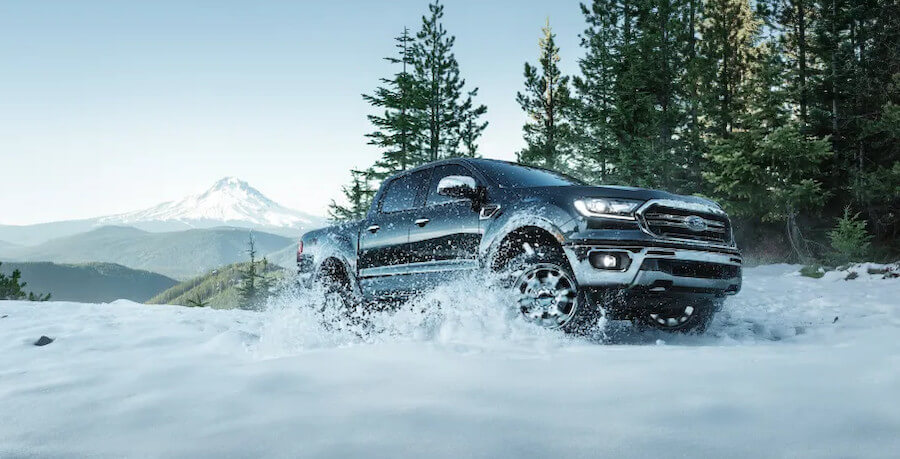
The Ford Ranger Wildtrak is engineered to deliver confident winter performance through a combination of advanced electronics and proven off-road hardware. Its part-time four-wheel-drive system allows drivers to engage 4H or 4L when conditions deteriorate, providing strong traction on snow, ice and loose surfaces while retaining efficient rear-wheel drive on dry roads.

Electronic Stability Control, Traction Control and Roll Over Mitigation work together to manage wheel slip and maintain directional stability, while Hill Start Assist and Hill Descent Control provide added confidence on steep or slippery gradients. The Ranger’s suspension setup and robust ladder-frame construction help it remain stable over uneven or rutted ground.

With approximately 229 mm of ground clearance and a wading depth of 800 mm, the Wildtrak is well suited to deep snow, flooded roads and challenging winter terrain, making it a dependable choice for drivers who regularly face poor conditions.

Toyota Hilux Invincible X

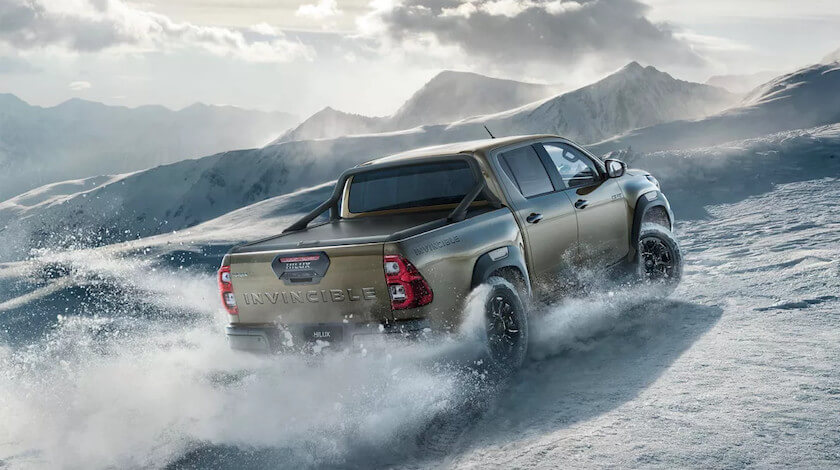
The Toyota Hilux Invincible X focuses on durability and traction, making it particularly effective in harsh winter environments. Its selectable four-wheel-drive system allows the driver to engage 4WD when additional grip is required, while the combination of Active Traction Control and Vehicle Stability Control helps maintain stability on snow and ice.

A key strength of the Hilux is its mechanical robustness. With up to 310 mm of ground clearance, it offers more underbody clearance than most rivals, helping it negotiate deep snow, rutted tracks and uneven surfaces with confidence. The inclusion of a rear differential lock further improves traction when one wheel loses contact with the ground.

Hill Start Assist and Downhill Assist Control support controlled progress on steep or slippery terrain, while the ladder-frame chassis provides the strength and durability expected from a work-focused pickup. Overall, the Hilux prioritises dependability and mechanical grip over outright sophistication.

Volkswagen Amarok PanAmericana

The Amarok PanAmericana delivers a more refined take on winter capability, combining strong off-road hardware with advanced on-road stability systems. Its permanent 4MOTION all-wheel-drive system continuously distributes power to all four wheels, providing consistent traction without driver intervention.

A range of selectable drive modes optimises throttle response and drivetrain behaviour for snow, mud and off-road conditions. The PanAmericana also benefits from Electronic Stability Control, Traction Control, Hill Start Assist and Hill Descent Control, all working together to maintain stability in low-grip environments.

With a ground clearance of 235 mm and a wading depth of up to 800 mm, the Amarok is well equipped for deep snow and water crossings. Its robust ladder-frame construction and refined suspension setup balance off-road strength with everyday comfort, making it particularly well suited to drivers who want both capability and refinement.

Isuzu D-Max V-Cross

The Isuzu D-Max V-Cross takes a slightly different approach, combining traditional off-road toughness with a strong focus on electronic assistance. Its shift-on-the-fly four-wheel-drive system allows the driver to engage 4WD as conditions change, supported by Rough Terrain Mode, which optimises throttle response and braking to maintain traction on loose or slippery surfaces.

The V-Cross also benefits from a rear differential lock, Hill Start Assist, and Hill Descent Control, all of which help maintain stability on steep or uneven ground. With a ground clearance of 230 mm and a wading depth of up to 800 mm, it performs confidently in deep snow and standing water.

Where the D-Max stands out is in its balance between capability and refinement. Advanced driver assistance systems, combined with a durable ladder-frame chassis, make it a reassuring option for drivers who want strong off-road performance without sacrificing day-to-day comfort.

VanLeasing’s Snow Performance Rankings

Four-Wheel Drive / All-Wheel Drive Performance

🥇 Volkswagen Amarok PanAmericana
Permanent 4MOTION all-wheel drive provides continuous, automatic torque distribution, delivering the most consistent traction on snow, ice and mixed winter surfaces, with no driver input required.

🥈 Ford Ranger Wildtrak
Selectable 4WD with low-range gearing offers excellent traction in deep snow and off-road conditions, though it requires manual engagement and is less adaptive on changing surfaces.

🥉 Toyota Hilux Invincible X
Traditional part-time 4WD with rear differential lock prioritises reliability and mechanical grip, excelling in harsh conditions but offering less adaptability on icy roads.

🔹 Isuzu D-Max V-Cross
Shift-on-the-fly 4WD with Rough Terrain Mode provides dependable traction on snow and loose surfaces, but with fewer adaptive systems than its rivals.

Ground Clearance

ModelGround Clearance
Hilux Invincible X~310 mm 🥇
Amarok PanAmericana~235 mm 🥈
Isuzu D-Max V-Cross~230 mm 🥉
Ford Ranger Wildtrak~230 mm 🔹

All are suitable for snow, but the Hilux Invincible X has the edge when driving through deeper, unplowed snow.

Traction & Stability Control Systems (Beyond 4WD)

While four-wheel drive plays an important role, real-world winter stability depends just as much on how a vehicle manages wheel slip, braking force, throttle input, and chassis behaviour. Modern electronic control systems often make a bigger difference than drivetrain layout alone.

  • ESC – detects yaw and lateral movement, braking individual wheels to prevent loss of control
  • Traction Control – limits wheelspin by reducing engine power or braking spinning wheels
  • Brake-based torque vectoring – redistributes torque side-to-side using the braking system
  • Throttle calibration – how smoothly power is delivered on slippery surfaces
  • Weight distribution & suspension tuning – affects grip and predictability
  • Tyre contact and load transfer – especially important on snow and ice

With that in mind, here’s a more accurate breakdown of how each pickup performs.

🥇 Volkswagen Amarok PanAmericana

The Amarok stands out not just because of its permanent AWD, but because of how its electronic stability and traction systems are tuned. The vehicle constantly monitors wheel speed, steering angle, yaw rate and throttle input, making frequent micro-adjustments to maintain grip.

Its system feels the most refined and predictive, particularly on icy or mixed surfaces where grip changes rapidly. Rather than reacting after slip occurs, the Amarok often prevents it from happening in the first place.

Why it leads:

  • Continuous torque distribution
  • Smooth, predictive ESC calibration
  • Excellent on mixed-grip and transitional surfaces

🥈 Ford Ranger Wildtrak

The Ranger’s stability systems are highly capable, particularly once 4WD is engaged. Its ESC, traction control and terrain management work well together to maintain stability in deep snow or low-grip conditions.

However, because it relies on a selectable 4WD system, it requires more driver input than the Amarok. Once engaged, performance is excellent, but the system is less seamless when conditions change rapidly.

Strengths:

  • Very effective ESC and traction calibration
  • Strong off-road and snow performance
  • Slightly less adaptive than full-time AWD systems

🥉 Toyota Hilux Invincible X

The Hilux prioritises durability and predictable behaviour over sophisticated electronic intervention. Its traction control and stability systems are effective but intentionally conservative, intervening more abruptly and allowing less fine-grained modulation than newer setups.

This makes it extremely reliable in tough environments but slightly less composed on icy roads or mixed-grip tarmac.

Strengths:

  • Dependable traction control
  • Excellent low-speed grip
  • Robust mechanical reliability

🟦 Isuzu D-Max V-Cross

The D-Max provides essential traction and stability systems, including Rough Terrain Mode, but these are simpler in calibration and response compared to rivals. They work well in slow, technical conditions but offer less refinement when surface grip varies rapidly.

This makes the D-Max dependable rather than sophisticated — effective, but not as confidence-inspiring in fast-changing winter conditions.

RankModelStability & Traction Character
🥇Amarok PanAmericanaMost advanced, predictive and refined
🥈Ford Ranger WildtrakStrong electronics with manual control emphasis
🥉Toyota Hilux Invincible XReliable, durable, mechanically focused
🟦Isuzu D-Max V-CrossFunctional and dependable, less advanced

Overall Winner

We now turn to the key question of which pickup performs best in winter conditions. To determine this, each vehicle was assessed across the three core factors outlined earlier, with particular emphasis placed on how effectively it maintains control in snow and low-grip conditions.

Greater weighting was given to traction management and stability control, as these systems play the biggest role in real-world winter safety.

RankModelOverall Winter Performance Summary
🥇 Overall WinnerVolkswagen Amarok PanAmericanaBest all-round winter performer thanks to full-time AWD, the most refined traction and stability systems, and excellent balance of grip, control and predictability.
🥈Ford Ranger WildtrakHighly capable, particularly off-road, but slightly less consistent in changing winter conditions due to selectable 4WD.
🥉Toyota Hilux Invincible XExceptional mechanical durability and ground clearance, though less electronically sophisticated than rivals.
🟦Isuzu D-Max V-CrossDependable and capable in winter use, but the least advanced in traction management and overall refinement.

Final Thoughts

While differences between these pickups become apparent in extreme conditions, all four are well suited to UK winters. Prolonged deep snow is relatively rare, and in normal winter driving each model offers ample traction, stability, and control. The real performance gap only emerges in severe weather or challenging terrain.

As a result, buyers should look beyond drivetrain capability alone. Practicality, comfort, and how well a vehicle can be prepared for winter use are often more important than outright off-road ability.

Simple preparations can make a significant difference. Adding weight over the rear axle improves traction in empty load beds, while underbody protection helps safeguard vital components on unploughed or rural roads. Carrying basic recovery equipment can prove invaluable in difficult conditions, and comfort features such as heated seats and steering wheels help drivers stay warm and alert. Finally, checking battery health, brakes, and suspension before winter helps ensure reliable, predictable performance when temperatures drop.