
Guides & insight
Will the UK Really Ban Petrol and Diesel Vans by 2035?
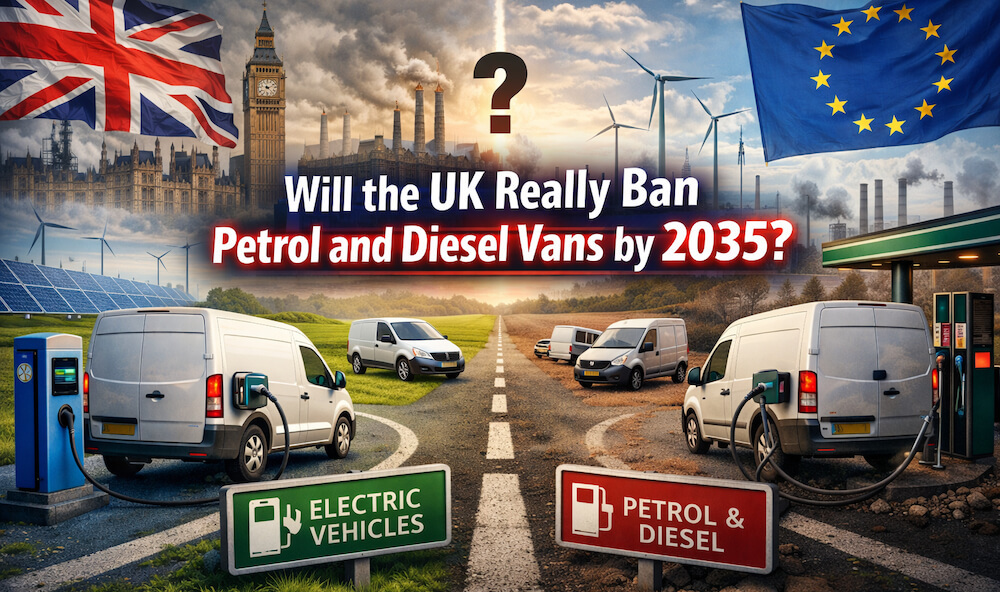
This article is not intended to act as a crystal ball or present hard facts. There is no way of predicting with certainty whether the UK will fully follow through on plans to end the sale of new petrol and diesel vehicles by 2030, and move entirely to zero-emission new vehicles by 2035.
However, while the policy sets out a clear direction, the market appears to be pulling another way. Demand, infrastructure, manufacturing and wider economic conditions all influence how realistic those targets are in practice. With that in mind, this article looks at how those factors may shape what actually happens over the coming years.
Setting out to lead the transition away from ICE vehicles is, in principle, a positive step. But targets do not exist in isolation. They sit within a wider system that needs to function alongside them. In some cases, that means balancing ambition with the realities of how markets, industries and supply chains respond over time.
Ultimately, the question is not just what has been set out on paper, but how closely real-world conditions will allow that timeline to be followed. While these targets apply to both cars and vans, the path to reaching them is not identical, particularly in the commercial vehicle market where operational demands are more complex.
What is the UK's current stance for 2035
The UK's current position is clear in principle, even if the path to get there remains open to interpretation. Under existing policy, all new cars and vans registered from 2035 must be zero-emission at the tailpipe. In practical terms, this means battery electric vehicles and, potentially, hydrogen-powered vehicles.
This follows an earlier milestone set for 2030, where the sale of new pure petrol and diesel vehicles is due to end. Between 2030 and 2035, some hybrid vehicles are expected to remain on sale, provided they meet specific criteria around electric-only driving capability. However, this is intended as a transitional phase rather than a long-term solution.
Policy Timeline
- 2020 → Target announced
- 2030 → End of new petrol/diesel sales
- 2035 → Zero-emission new vehicles only
It is important to distinguish what this policy does and does not do. The 2035 deadline does not remove existing petrol or diesel vehicles from the road, nor does it prevent their use or resale in the second-hand market. Instead, it focuses solely on new vehicle registrations, meaning the overall shift in the vehicle parc will take place gradually over time.
The policy is also being delivered through the Zero Emission Vehicle (ZEV) mandate, which requires manufacturers to increase the proportion of zero-emission vehicles they sell each year. This creates a steady progression towards 2035, rather than a sudden, absolute cut-off.
While the 2035 end point applies to both cars and vans, the ZEV mandate sets separate annual targets for each. In practice, this means vans are expected to transition at a slower pace than cars in the years leading up to 2035, reflecting the additional challenges associated with electrifying commercial vehicles.
Europe changes direction
While the UK continues to set out a clear end point for new petrol and diesel vehicles, the direction across the European Union is beginning to shift.
The EU's original policy centred around a full phase-out of new internal combustion engine vehicles by 2035, requiring a 100% reduction in tailpipe emissions. In practice, this would have limited new vehicle sales to fully electric or equivalent zero-emission technologies.
However, that position is now evolving. Rather than maintaining a strict, one-dimensional pathway, there is a growing move towards a more flexible, technology-neutral approach.
At the centre of this shift is Germany, which has pushed for a framework that allows multiple technologies to contribute to emissions reduction. This includes the potential continued use of hybrid vehicles, as well as combustion engines powered by synthetic or low-carbon fuels.
As a result, the conversation at EU level is moving away from a complete ban towards a target-based system, where emissions are reduced significantly but not necessarily eliminated through a single solution. This opens the possibility for a broader mix of technologies to remain in the market beyond 2035.
This change in direction reflects wider pressures facing the automotive sector. EV adoption, while growing, has not accelerated at the pace some had expected. Costs remain high, infrastructure continues to develop unevenly, and manufacturers are facing increasing competition on a global scale.
While these changes are still subject to review and not all elements are fully confirmed, the overall trajectory is clear. The EU is beginning to prioritise flexibility and industrial practicality alongside its environmental targets.
For markets closely linked to Europe, including the UK, this shift may prove increasingly important.
Why Vans Are Proving Harder to Transition
While policy treats cars and vans under the same end goal, the reality on the ground is more uneven. Adoption of electric vehicles has grown strongly in the passenger car market, although arguably not at a pace that fully supports the 2035 timeline, but uptake in the van sector has remained comparatively low.
Part of this reflects the nature of the vehicles themselves. Vans are working assets, and their performance is closely tied to how they are used day to day. Payload, route variability and time-sensitive schedules all introduce factors that do not apply in the same way to passenger cars.
Here's a breakdown of several factors that help explain why electric van adoption has progressed more slowly than in the passenger car market.
1. Slower technological development
The technology itself is less mature. The van market is smaller, and as a result, manufacturers have typically prioritised passenger vehicles when bringing new electric platforms to market. This has left electric vans a step behind in terms of range, efficiency and overall development.
In response to these limitations, some manufacturers, such as the Ford Transit Custom PHEV, have introduced plug-in hybrid alternatives. These combine a limited electric-only range with a petrol engine, offering greater flexibility for mixed-use driving. However, this approach is not without compromise, as some operators find the smaller petrol engines less suited to heavier-duty applications compared to traditional diesel equivalents.
2. Variable payload and its impact on range
Operational use adds further complexity. Unlike cars, vans carry loads that can vary significantly from day to day, depending on the job. This variability has a direct impact on range, making performance less predictable and more difficult to plan around in real-world conditions.
This is further compounded by the weight of the battery itself, which reduces available payload capacity and means that any additional load has a more immediate impact on efficiency.
3. Real-world range and environmental factors
While official electric range figures provide a useful benchmark, real-world conditions can reduce usable range significantly. Factors such as motorway driving, stop-start usage and payload all influence performance, but environmental conditions play a key role as well.
In colder weather, battery efficiency decreases and additional energy is required for heating, reducing overall range. In warmer conditions, energy is diverted to cooling systems to maintain battery performance. As temperatures move away from optimal conditions, battery efficiency can fall to around 85% at both low (0°C) and high (around 40°C) extremes. These temperature-related effects not only reduce usable capacity but also increase internal resistance, which can slow charging performance.
For businesses operating consistently throughout the year, this introduces a level of variability that can affect route planning, scheduling and reliability, whereas ICE vehicles are far less exposed to these fluctuations.
4. Size and weight limitations
Vehicle size also plays a critical role. As vans increase in size and payload capacity, range tends to decrease, which can limit their practicality for longer-distance or higher-demand use cases. While smaller electric vans are beginning to offer more competitive ranges and are becoming increasingly viable for certain applications, this progress is less evident in larger, heavier segments.
In some cases, smaller electric vans can offer closer-than-expected usable payload compared to larger models, as battery weight reduces the effective capacity of heavier vehicles. This can feel like there's a mismatch between load volume and payload, where the available space cannot be fully utilised without exceeding weight limits.
5. Charging time and operational downtime
Refuelling a conventional vehicle is a short and predictable process that takes mere minutes. Charging, even under rapid conditions, introduces longer and less flexible downtime. For private users this may be manageable, but for commercial operations it can directly impact productivity.
Time spent charging is time a vehicle is not in use, and when combined with range limitations, this can restrict how many jobs or deliveries can be completed within a working day.
Why the UK can't ignore Europe's shift and what it means at home
Taken together, this raises a broader question around how realistic the 2035 timeline is in practice. While the direction of travel is clearly defined, the pace at which both the market and the wider industry are moving tells a more measured story.
Even within the passenger car market, where adoption has been strongest, the transition remains at a relatively early stage when measured against the total vehicle parc. While growth has been significant, it remains incremental, and arguably not close enough to be considered a complete shift.
In the van market, this gap is more pronounced. Adoption has progressed more slowly, the technology remains less mature, and the operational demands placed on these vehicles are more complex. Vans are not simply modes of transport, but working assets, and their viability is closely tied to consistency, uptime and flexibility.
Did you know? In 2020, when the UK first set out its 2035 target, there were roughly 150,000 electric cars on the road. Today, that figure has risen to around 1.8 million. By comparison, the electric van market has grown from around 5,200 vehicles to approximately 109,000 over the same period.
For many businesses, the shift to electric vans is not just a question of cost, but of operational reliability. Range variability, charging downtime and payload limitations all introduce constraints that do not exist in the same way with conventional vehicles. This makes large-scale adoption more difficult to implement within fixed timelines.
However, these challenges do not exist in isolation. The UK automotive market remains closely linked to wider European manufacturing and supply networks. As regulatory approaches begin to diverge, this can influence how manufacturers allocate production, investment and resources across different regions.
Across the European Union, there is a growing shift towards a more flexible, technology-neutral approach to emissions reduction. Rather than relying solely on fully electric vehicles, this opens the door for a broader mix of technologies, including hybrids and alternative fuels, to play a role beyond 2035.
In practical terms, this may affect how manufacturers prioritise production. If demand in European markets supports a wider range of technologies, production capacity may be distributed accordingly. This could limit the volume of fully electric vans made available to markets with stricter requirements, particularly where those markets represent a smaller share of overall demand.
Production scale also plays a role. Vehicle platforms are typically developed and manufactured for multiple markets, and depend on sufficient volume to remain commercially viable. If a particular electric platform is not being produced at scale across Europe, it may not be prioritised for the UK market in isolation. Over time, this can influence availability, pricing and lead times.
There is also a question of competitive balance. If manufacturers are able to operate under more flexible conditions in one region but face stricter requirements in another, it can affect how investment and innovation are distributed. This may shape not just the availability of vehicles, but also the pace at which improvements in cost and technology are passed through to end users.
Taken together, this suggests that while the direction of travel is unlikely to change, the current trajectory of both the car and van markets points towards a transition that may take longer, and prove more complex, than the 2035 target implies.